
Crazing the Glaze: Understanding the “Grief Brain” After Loss
After trauma, people often say, ‘I wasn’t myself.’ The truth is, neurologically, they weren’t. It’s called “grief brain.”
Hello friends! If this is your first time reading here, I would love to give you a warm welcome. If you have followed my journey before, thank you. I think often, how little time we have; the fact that you are spending some of yours here means a lot to me. I never want what I “say” to be a waste of your time…so, I’ll get right to it.
As much as I can, I start my day by reading the Bible and sitting in front of my red light (I’ll talk more about the red light soon-I love it!) I use a “Read through the Bible” app on my phone. Some days my mind is full of thoughts while I sit at the table; other days, it is quieter. I don’t know why the quiet comes, but I don’t complain. I like the stillness.
Recently, my mind took me back to the days and weeks after Bill passed away in 2021. I found myself wincing, a physical response to the memory of the pain. I don’t go back there often because it is so difficult, usually just say to myself, “Thank God I’m not there anymore.”
But now, I’m revisiting it. I plan on writing in detail about the specific things that happened in those days and weeks but I wanted to do some research on what actually happens to the mind after severe trauma because what happened to me, and what happens to so many, was nothing short of a sickness unlike anything else I’ve known.
How do I describe those days? Blurry. Abstract. Shattered. It was a pain that could not be relieved. Even when the sun was out, it was as if a haze was blocking the light. It never felt sunny. Nothing was normal; nothing felt good. My mind could not settle. I was out of my mind.
The Science of Feeling “Crazy”
If you are experiencing this now, please know: this time does not last forever. You will get through it. You are in the thick of it, but it does get easier.
When we talk about “Grief Brain,” we are talking about the parts of the brain that are physically affected: the amygdala, the prefrontal cortex, and the hippocampus. I want to break these down separately in a future post, but today I want to zero in on the concept of feeling crazy.
Loss is uninvited. I never wanted to think about it. I knew that someday, Bill or I was going to leave first. The odds are 50/50. To be honest, I hoped I would be first to go because I knew that facing my life without Bill would be unbearable.
Not only did we not grow old together, but he left nearly half a lifetime earlier than I hoped. The “crazy” commenced.
I was not prepared. It was a shock.
The Etymology of a Broken Heart
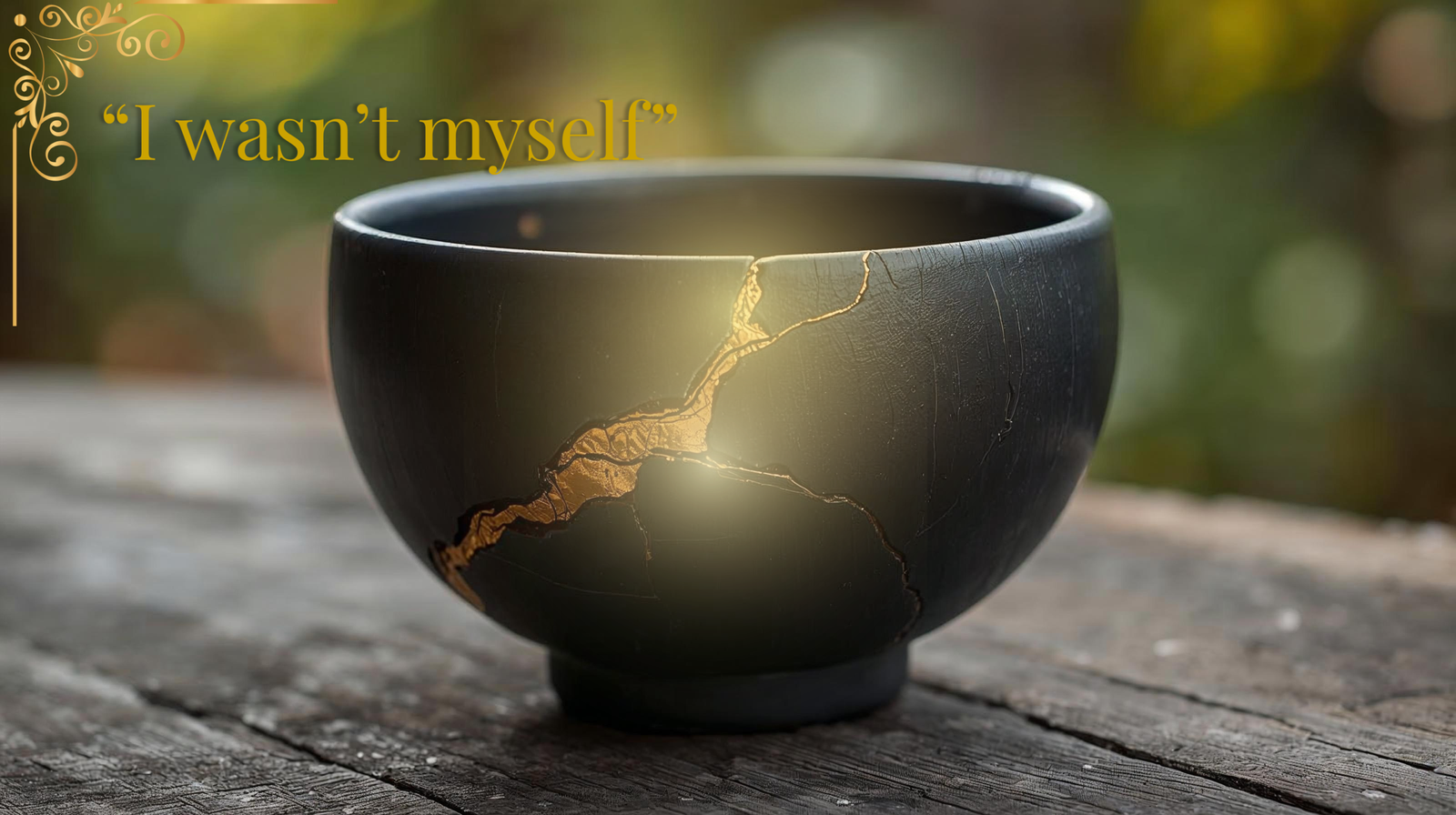
I read that the word “crazy” comes to us from the 14th-century Germanic word crasen, which meant “to shatter, crush, break into pieces.”
Fine china can undergo something called “crazing” which is when the glaze forms a web of fine lines, shattering into tiny sections. I’ve seen this. Early grief is a similar shattering. It crushes us into a million pieces. It’s no wonder we describe ourselves as “broken.”
As I research what happens to us after a spouse passes away, it brings me comfort to know that what I experienced is a normal biological response. What I learned is that initially, shock and numbness exist as a protective mechanism so we don’t shatter instantly into our new reality. It serves as an anesthetic.
During this time, you might experience intense crying, angry outbursts, shaking, or even fainting. Manic behaviors can also enter in; cleaning out the garage, closets, pacing or talking nonstop.
As I typed that, I remembered the night Bill passed. A close friend sat on the sofa until 4:00 AM while I paced back and forth, talking uncontrollably for five hours. I walked so much I created a blister on the inside of my foot.
Surrealness and Dissociation
I want to end by briefly mentioning surrealness. This resonated with me deeply. I remember sitting outside a few days after he passed; the lake, the grass, and the sky felt artificial. The light of the sun looked like sepia tones. Life felt like a bizarre dream, almost like living in an artificial world.
Others experience dissociation, a feeling of being somewhere but not actually there, disconnected from the experience of which you are in the middle.
We are complex beings. Our minds are protective. Everything I have described is, in my opinion, a mechanism designed by God to keep us from completely losing our sense of self. It lasts for a time, and then it begins to recede.
These biological shifts are designed to protect our sense of self when the world stops making sense. But once the haze begins to lift, we are left with a deeper question: Who am I now that the ‘we’ is gone? If you are struggling with that shift, I’ve written more about the long journey of finding my new identity and how we begin to piece the ‘self’ back together.”
https://juliedigitalcreation.online/finding-my-new-identity-after-loss/
I hate the word death, but I know that Jesus conquered it.
I’d like to share a link to a podcast by James Walden. His zeal for Jesus is wonderful, and he describes what Jesus did in a way I’ve never heard before. I pray it blesses you.
Start at the 24 min. mark to about 27 min.
https://www.youtube.com/watch?v=N5jMMFD_Bxs&t=4086s
I’ll be back soon to talk more about the brain and the path to healing.
Until then…
Love, Lost Loved Found xoxoxoxo





One Comment